The 3D Difference


We build power-conscious, collaborative, and just organizations—not through symbolic programs, but through structural transformation that makes organizations both more functional and more equitable.

A DIFFERENT PARADIGM

Our NextGen Paradigm: PBJ
In a moment when Diversity, Equity, & Inclusion (DEI) is politically vulnerable and organizationally scrutinized, it's worth asking: what was DEI actually trying to solve? The impulse was right—organizations needed to reckon with inequity, create space for difference, and build environments where everyone could thrive. But the execution often fell short.
You can diversify a workforce, mandate trainings, and measure representation—and still have decision-making concentrated at the top, cultural toxicity thriving, and inequitable outcomes baked into governance and operations. Why? Because identity-focused approaches miss the systems, structures, and power dynamics that actually shape who thrives, who's heard, and what gets done.
Power, Belonging & Justice (PBJ) offers a paradigm shift.
PBJ regrounds the conversation in what is foundational for impact: building functional, resilient, effective organizations—while embedding the justice and equity outcomes DEI aspired to but often failed to achieve. PBJ moves beyond surface-level metrics to examine what actually drives both dysfunction and opportunity: power dynamics, systemic belonging, and structural justice.

POWER
How control, decision-making, & influence are structured and exercised. A power-conscious organization examines who holds influence, how decisions get made, & whether structures enable or constrain agency. POWER examines how all forms of power flow efficiently, transparently, & in ways that maximize organizational capacity while minimizing bottlenecks & concentrations that breed dysfunction.
BELONGING
The foundational force that enables each person to contribute courageously & meaningfully and actualize their agency. Belonging moves beyond "inclusion" (being invited to the table) to focus on whether people feel integral to the organization's mission & empowered as co-creators & stewards to the degree they desire. It’s a structural necessity that drives creativity, resilience, & collective commitment.

JUSTICE
As both destination & process—Justice requires precision & emphasizes creating responsive, adaptive systems that precisely see & address past harms, manage current complexities, anticipate future needs, & mitigate future harms. Fundamentally, it centers on establishing processes & conditions that allow power to be exercised in principled ways that are attuned to historical realities and supportive of repair, resilience, and sustainable growth.
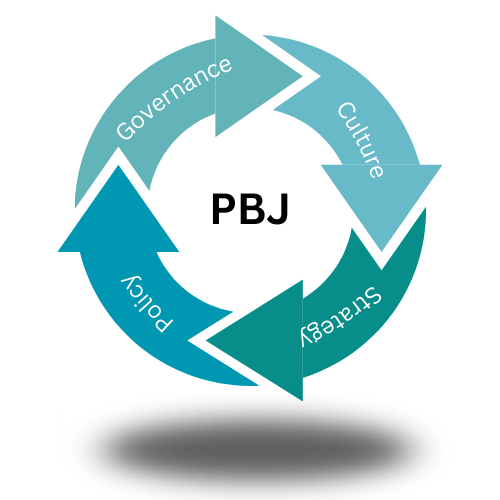
Power-conscious, collaborative & just organizations calibrate across Four Pillars of Org Functionality
A DIFFERENT APPROACH
The Typical Approach
Traditional approaches silo organizational challenges. You hire a "governance consultant" or a "culture consultant" and they treat symptoms in isolation. Culture gets separated from structure. Strategy gets disconnected from governance. DEI becomes its own initiative rather than something embedded across systems.
But we see things differently.
Most organizational challenges don't live in just one pillar—they emerge from how systems interact. A "culture problem" is often rooted in governance structures. A "strategy issue" may stem from unclear policies or misaligned decision-making. A board struggling with "decision-making" may actually be dealing with unclear strategy, misaligned policies, and cultural dynamics that make dissent risky. A team "stuck on fundraising" may be masking a deeper conflict over competing strategic visions.
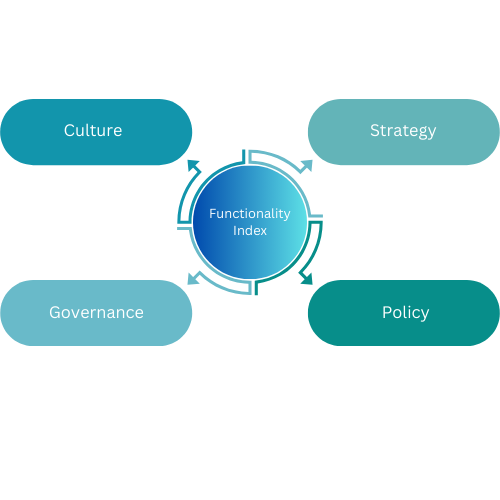
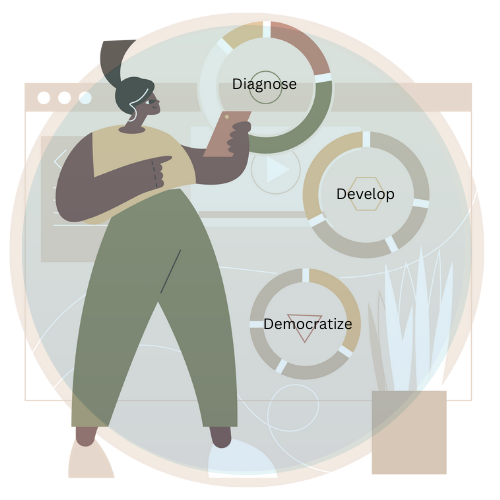
We diagnose, develop, and democratize processes across four interconnected pillars:
Governance: How power, authority, & decision-making are structured, exercised, & legitimated
Strategy: How vision, goals, & resource allocation are defined & pursued and algned with values & desired impact
Policy: The formal & informal rules, processes, & systems that guide operations
Culture: The norms, values, relationships, and dynamics that shape daily work
This integrated approach reveals the real dynamics at play—not just isolated symptoms.
OFFERING MORE PRECISION & POSSIBILITY
A DIFFERENT MODEL
PBJ Across The Four Pillars is a methodology that changes how we partner with teams to create organizations that are more functional because they're more just. More resilient because they're more collaborative. More effective because they've aligned people, power, and process in ways that unlock capacity rather than cannibalize it.
In Culture:
Not just measuring "employee satisfaction" but diagnosing power dynamics in feedback loops, psychological safety across hierarchies, and whether belonging is structurally supported or performative.
In Governance:
Not just adding "diverse board members" but examining decision-making structures, information flows, accountability mechanisms, and whether governance systems concentrate or distribute power effectively.
In Strategy:
Not just "stakeholder engagement" but assessing whose perspectives shape priorities, how trade-offs are navigated, and whether strategic processes create collaborative ownership or top-down compliance.
In Policy:
Not just "anti-discrimination policies" but building systems that surface and address power imbalances, enable recalibration when harm occurs, and align rules with both equity and functionality.